
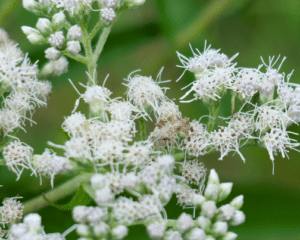
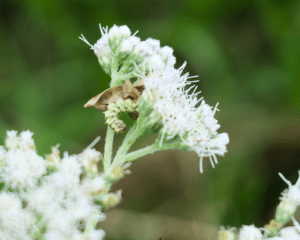
The Wavy-lined emerald moth (Synchlora aerata-frondaria) is a moth species native to the northeastern United States. Hidden on these boneset flowers are two of the moth’s caterpillars. The caterpillars are remarkable for their ability to camouflage amongst the plants that the caterpillar feeds on. In this case, the caterpillars have grabbed little bits of the leaf of the plant to cover themselves, and are pretending to be dead leaves. Each caterpillar goes through stages, called instars. They molt and grow throughout this larval stage. As they grow, they add more and more pieces of material to their back, discarding old pieces when needed. Another way they add to their camouflage is by mimicking the way plants sway in the wind. this is called “looper” behavior.
The emerald moth caterpillars can be found (although they don’t want to be) among many common flowers like daisies, goldenrods, asters, raspberries, and roses. They are most active early in the summer, but they spend the winters (called overwintering) as pupae, to come back out in the following spring. Consider planting some of these native flowers in your own garden to give space for our critter friends to flourish.
These critters can be very hard to spot, but when you take some time out of your hike to breathe and witness the world around you, you never know what you might see. These pictures were taken on our Hickory Loop Boardwalk, where there’s lots of boneset and goldenrod flowering this week. Let us know if you find any critters among the bloom!