Saddleback Caterpillars:
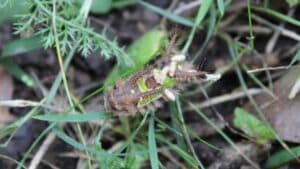
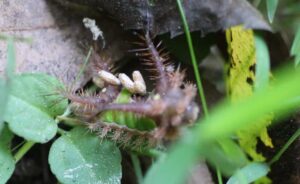
These aren’t quite the cowboys this saddleback caterpillar (Acharia stimulea) was hoping for… Named for the distinctive green pattern on their backs, these caterpillars are natives to eastern North America. As you can probably guess from its looks, this caterpillar is full of defenses. The stark green color of the “saddle” is a warning to predators, telling them to watch out! This tactic, called aposematism, is used by many animals, from frogs, to fish, to even mammals, like skunks.
It also has brown spines (sometimes referred to as tentacles or tuberances) all along its body, which are filled with a venom that is quite toxic to humans. These spines are called urticating hairs, and they are a common defense mechanism among plants and tarantulas. This species is considered to have one of the strongest stings of all caterpillars so if you see one, don’t touch it! Learn more about the health risks, and the caterpillar, here: https://ask.ifas.ufl.edu/publication/IN923
Braconid Wasps:
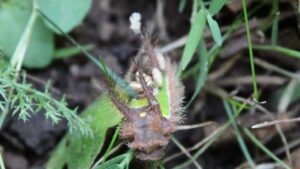
Unluckily, This particular saddleback caterpillar will not get to use these defenses for very much longer. Those beige, egg shaped protuberances on its back are parasitoid wasp cocoons! This friend has been infected by a species of wasp that lays eggs in hosts so its larvae can eat and grow on the insides of a poor unsuspecting host insect. The wasp in question is likely a part of the Braconidae family, although without seeing the adult it’s difficult to say what species.
These wasps have long ovipositors, the organ used to lay eggs, in order to bypass the defenses of their hosts. In order to bypass the hosts’ immune system, the wasps developed a template to create a specific kind of virus called a polydnavirus, which suppresses the immune system. The virus is considered an endosymbiont of the wasp. This means that the virus grows within the wasp, connected to its DNA. It’s like how mitochondrion were once their own organisms, but now live in our cells!
Once the larvae are finished feasting, they pop out of the skin of the caterpillar, and make a cocoon. This cocoon is attached to the skin so they can continue nourishing themselves on the host. Eventually, the wasps hatch out of their cocoons, eat the caterpillar, and fly off to continue this cycle of parasitism.
GROSS!